
With one weekend left of the 2026 Winchester Photographic Society Exhibition, now is the time to see this superb show. We got the chance to speak to photographer Eric Blake, who won the ever-popular scapes category. In this article, Blake, a club veteran, gave us insight into his entries and the exhibition.
What brought you to photography? Has it always been your preferred medium?
My father was a keen photographer. He gave me one of his cameras – a Chinon CE-5 film camera – and that’s where it all started. The more I used it, the more hooked I became.
I tried a few courses and even started an A-level in photography, but I dropped it. The history part was painfully dull – the teacher simply dictating from books – and it killed any enthusiasm in the classroom.
Joining Winchester Photographic Society (WPS) in 2006 is what really changed things. I arrived as a complete beginner, just before we moved to The Arc. I’m quite competitive by nature, so I was determined to learn as much as I could. My new club friends taught me a huge amount. I gained my LRPS in 2013 which, although stressful, was very pleasing.
Entering competitions was key. You quickly learn what makes a picture sing – and what kills it. The feedback, the scores, the comparisons with other images: it’s a fast track to improving.
Over time I was promoted through the internal classifications, then later served as Digital Secretary and, in 2016, as President. Being active in WPS has been incredibly rewarding. The club only thrives because members volunteer, and it feels good to give something back.
This year you excelled in the “Scapes” category. Tell us about the images that stood out.
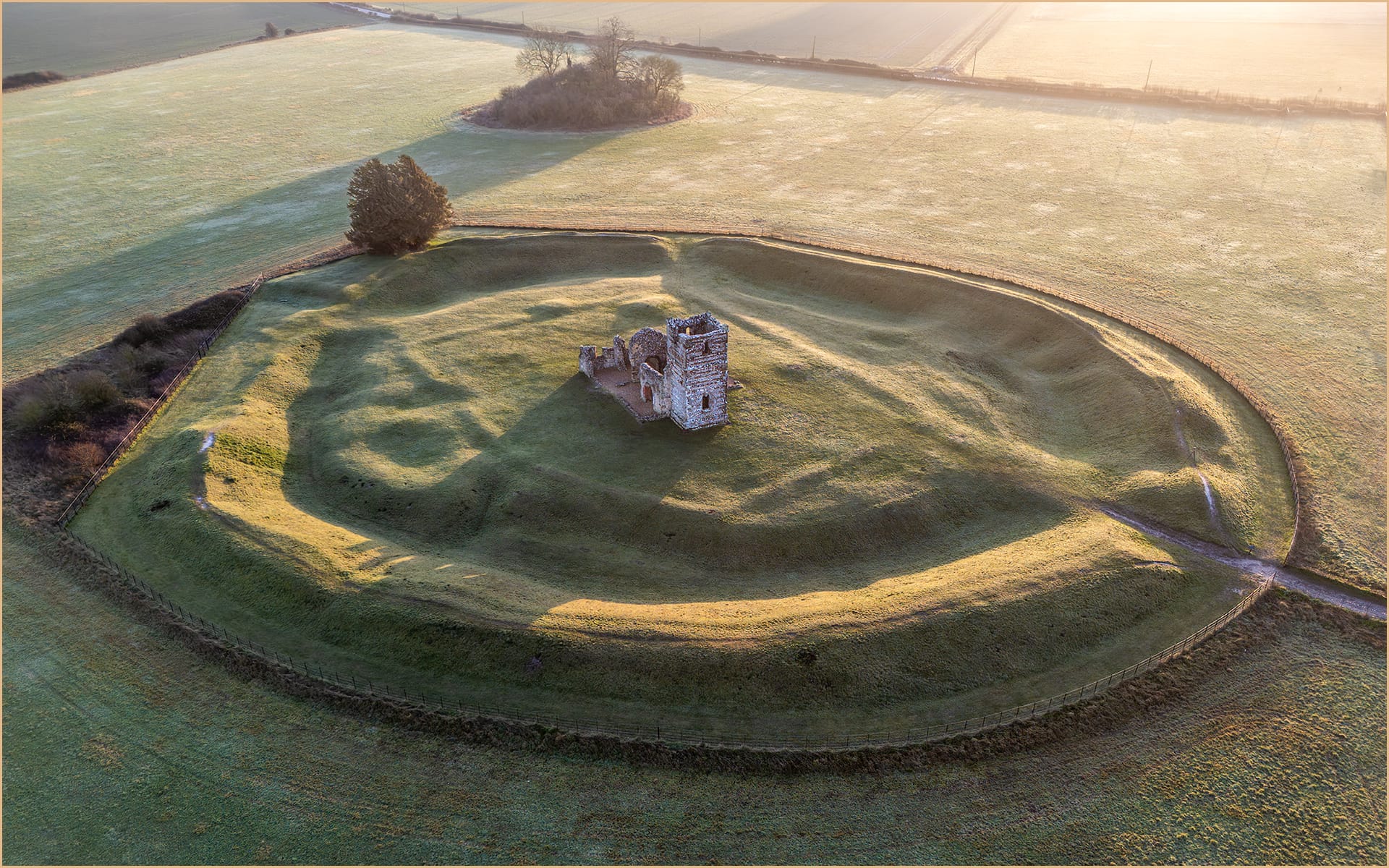
Knowlton Church at Sunrise
Knowlton Church at Sunrise was a very enjoyable shoot. Normally, I meet another member on a Friday and we sensibly start around 10am. But on this occasion, one of the “Friday boys’ club” said, “Fancy doing a dawn shoot?” I jumped at it. The other usual member would never have agreed to that sort of early start!
We decided on Dorset. I picked him up at 6:30am to catch a 7:50am sunrise, and we headed straight to Knowlton Church. Jack Lodge, a very talented Dorset-based photographer who’s visited our club, had shown us some of his images from there, and we thought, “Let’s see what we can do with it.”
I took my usual Canon and tripod and got plenty of pleasing shots from the ground. Then I started to mix things up, shooting the sunrise while flying the drone. The low light was perfect for long shadows and texture.
Knowlton Church at Sunrise is a bracketed image – three exposures combined. In post-processing, I worked on bringing up the shadow detail in the church. Modern cameras
and software are remarkable for this: the contours and textures just emerge beautifully. The final result was very satisfying and ended up as the outright winner in the category.
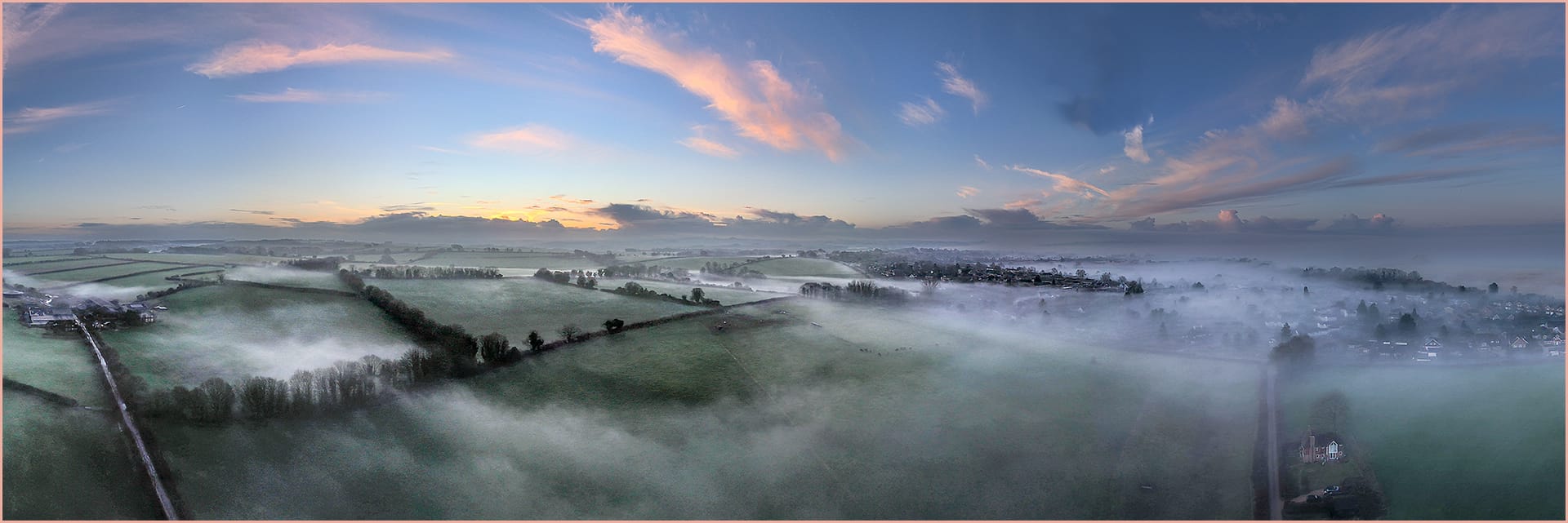
Mist Over Kings Worthy
The evening before I took Mist Over Kings Worthy, I remember thinking, “If there’s mist tomorrow, I’ll get the drone up.” Sure enough, the conditions were ideal the next morning. I kept an eye on it for a while – watching, waiting – then suddenly thought, “Right, go now.”
I walked out into the garden, launched from the patio, and in about five minutes of flying I took around a dozen frames. One of those became the final image, a panoramic landscape.
The drone captured a series of overlapping shots and stitched them together in-camera. A bit of post-processing at home on the computer quickly turned that into a very pleasing panorama.
Both landscape images scored 14 points, so the judges had to choose between them for the outright winner. In the end, Knowlton Church at Sunrise took the top spot.
How does the exhibition selection process work?
We use three experienced judges, carefully chosen by Trevor Morecraft. Each judge works independently at home, viewing the images on a calibrated monitor.
They typically look at each image for just a few seconds and then score it out of five, with five being the maximum. In practice, two is usually the lowest score – and a two means the image won’t make the exhibition.
Crucially, the judges don’t see each other’s scores. The totals are then combined, and those cumulative scores decide which images are accepted for the exhibition.
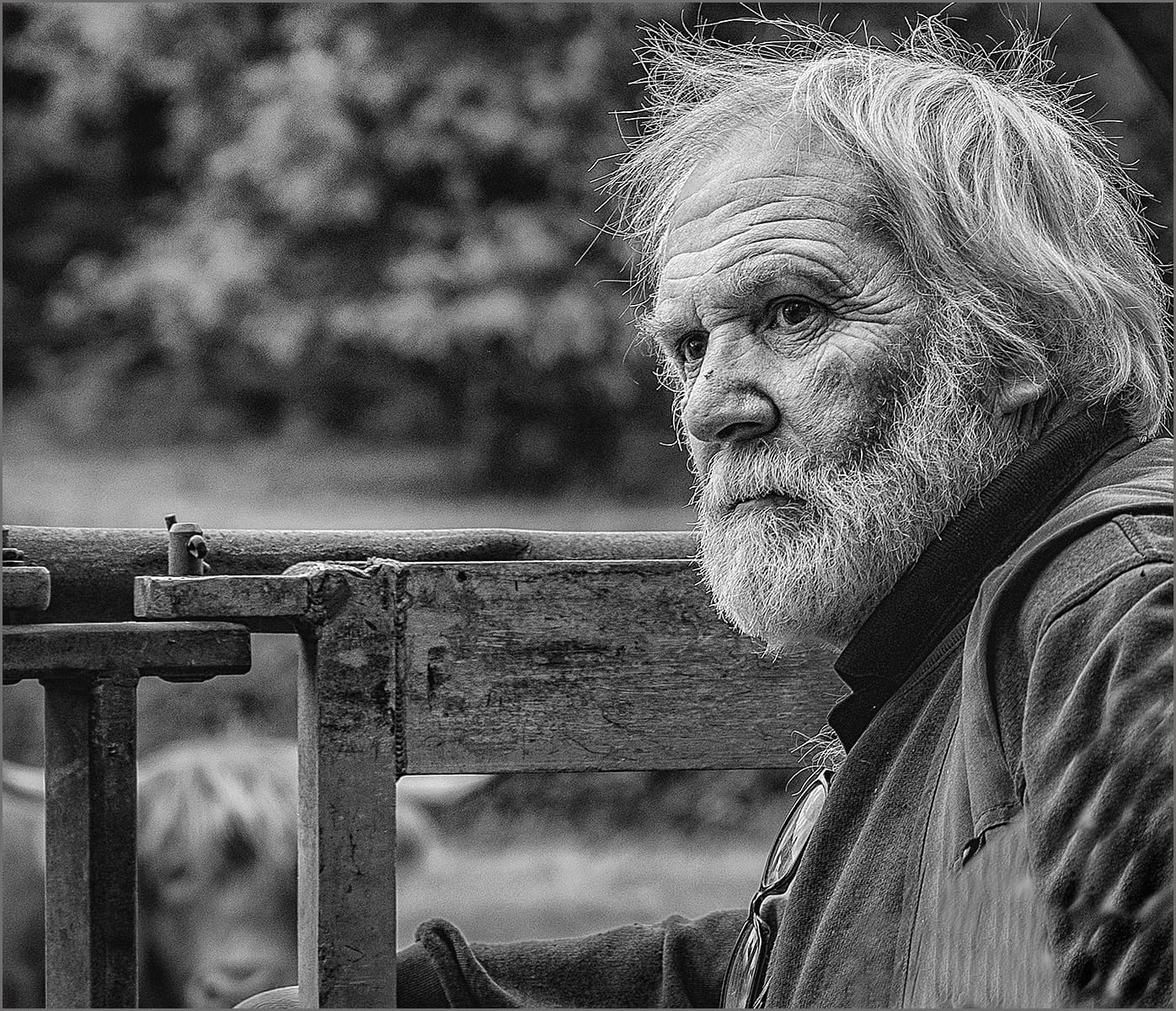
Farming is stressful
Eric also got the portrait Farming is Stressful into the exhibition. The title offered a succinct reading of the subject, thereby assisting the judges in their understanding.
As a long-standing member, what do you think makes WPS special?
There are many reasons Winchester Photographic Society is one of the strongest clubs in the South.
First, the standard of photography is high. We have a core of excellent photographers producing consistently impressive work, which raises everyone’s game.
Second, there’s a real variety of activity. We now have different user groups, including the Drone Group set up by Tony Large, which has grown to around 25 members and is great fun. I thoroughly enjoy running the Improvers group with Trevor – it’s been very successful and remains well supported.
Our Programme Secretary, Stellar Chandler, also deserves a mention. She’s found some fantastic speakers this year and given us some superb evenings – all for what is a very modest
membership fee. If you break it down per meeting, it’s about the price of a cup of coffee. That’s outstanding value.
But above all, it’s the people. The social interaction, the friendships, the banter, the shared trips and side projects – those are what keep you coming back. I’ve made some very good friends at WPS, and I’m sure those friendships will last until we’re too old to hold a camera.