In this third interview, painter Jenny Muncaster highlights the ingredients that are key to the success and joy of her artistry. Revealing much about her Still Life paintings, these assemblages of shapes and colours emerge as never-ending experiments, many of which are on display at the Arc, Winchester, in the exhibition, The Colour Factory Artists: The Every Day.
Where did your passion for art begin?
I studied printed textile design at Winchester School of Art and I loved the idea of the breadth of experimentation with surface, layers and texture. I was drawn to the Winchester School of Art because it was very drawing-based at the time. Drawing is fundamental to what I do.
When I was doing my textile design degree, the work I was doing was mainly pictorial, and showed my passion for travel, food and nature contextualised into little vignettes of storytelling, so they were never really intended to be like commercial prints. I take a playful and illustrative approach to still life.
The foundation of a printed design degree was good, as there was quite a bit of freedom to be experimental, I could explore lots of ideas. That is what I loved. That’s how I met Rachael, whom I share a studio space with now. We have worked on loads of more commercial painting projects together from large artworks for hotels and restaurants to street art and murals. At art school because I was diving into painting and printmaking studios, a lot of those influences affected my work. There was a bit of freedom in exploring the potential of other disciplines and techniques.
It worked out and I think if I had gone and done Fine Art, I might not do what I do now. I love all different kinds of influences including design and printing. So now I adopt the feeling of that printed effect but, in a hand-painted way. I'm layering colours and texture on top of each other to get the effect that I want, in a painting rather than a print on fabric. I'm more interested in the canvas, and the paper and the marks on those surfaces. I want to create paintings, pieces, sketches and sketchbooks. That's what excites me, but I'm very much process led. It is mainly about the process and the doing of it. It's all about the journey of what materials do for me. I explore questions like how various art materials apply or work on different surfaces and textures, and how I can include that in my final piece.
What inspires your choice and treatment of Still Life subjects?
Food is a massive influence. My happy times were with my mum in the kitchen preparing and making food. Picking the runner beans in the garden, going to the local fruit and veg markets and coming back and preparing stuff.
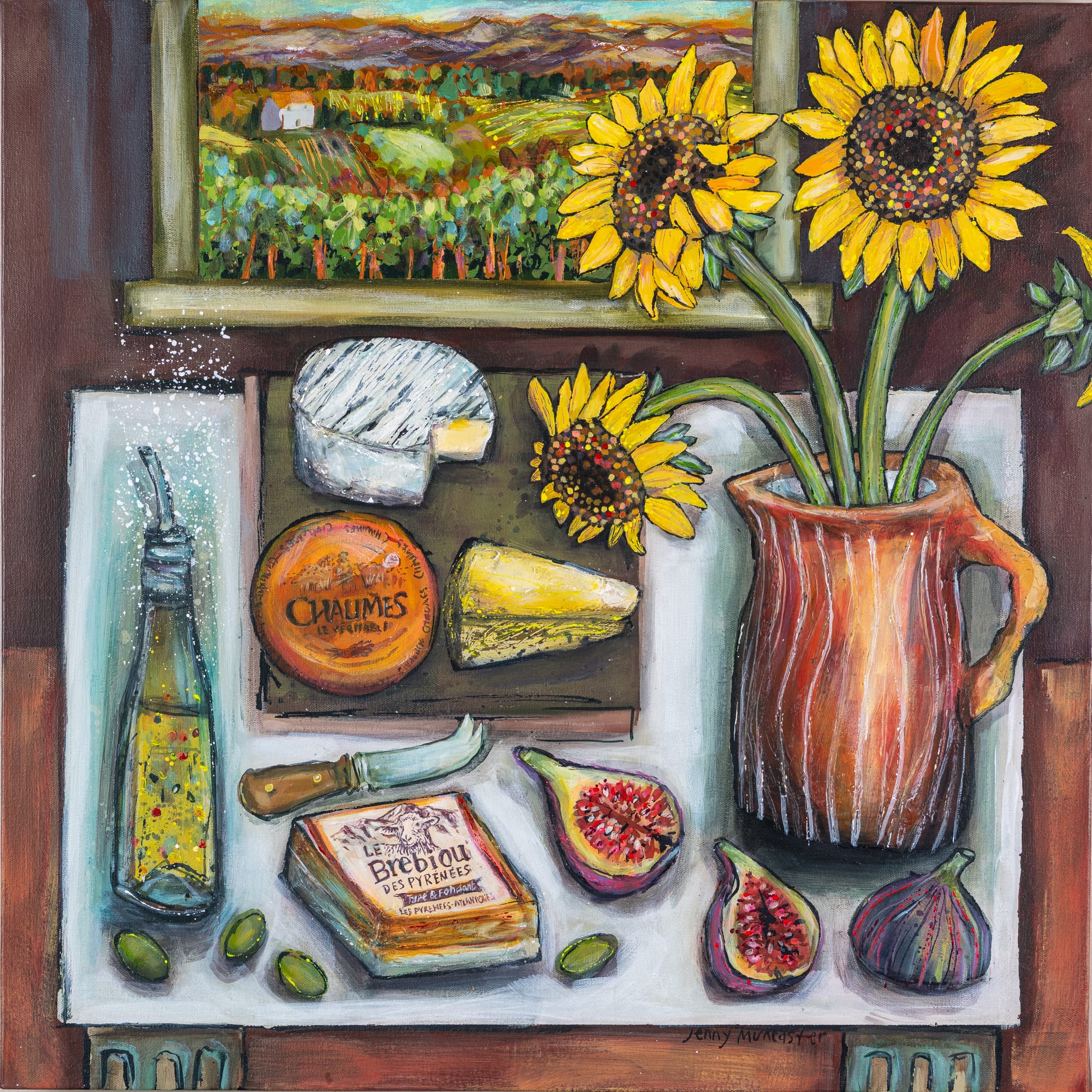
Enticing depictions of fresh produce permeate the Colour Factory exhibition at the Arc.
The ingredients for making a dish are like paints. I love the theatre of chefs preparing dishes and the story of where the food comes from. On holiday, for instance, I want to see the local fish market, and I want to see the boats where they bring the catch in and meet the people or the families that bring it all together. I love the storytelling element of that.
I've always enjoyed the idea of sketching in a cafe and taking in the scene. Whether I’m away somewhere or at home, the cup of coffee, wrappers, receipts or the pastries on a plate - it’s all part of that experience - that moment. All these everyday things become part of a painting, the domesticity of it. The human elements become part of my still life.
So, I started to develop this way of creating stories by doing what I call table lays. I am slightly changing the perspective, maybe looking down on the main object that interests me and then the flattened perspective of a jug and the pattern of that, then a box of tea and the text on it. It all becomes part of that pattern and arrangement. Every chosen object tells a story and can be personalised.
To be honest, I still want to abstract more. Probably the reason why I keep painting is because it's never quite how I want it to be. I do a loose drawing, and that is the inspiration; then when I start painting, it becomes a different version of that drawing sometimes tighter than I want it to be in places. Then I must do another one, and I think that's just this artistic desire to keep improving and keep pushing the artwork, to get to the place where you want to get to.
That's the impetus for keeping going. I've got to get there. I've got to finalise my ideas and keep going with it. Within that, it is that whole process of colour and texture. Maybe the Jug has got an interesting pattern on it, so I don't just paint that with a brush; I make a stencil, and whoosh thick paste through the stencil, and it sticks out of the canvas, and then I put another colour on top of that, and it drips and creates a different surface. It is quite textured and layered, and I want people to wonder how it is made and question whether it’s even actually painted with a brush. I like using different tools to make marks; these can range from a bit of cardboard, a feather, a knife, to a fly swat. You can print with a fly swat and make a texture. I'm always interested in layers of different paint effects. I’m trying to be looser and have more freedom and slightly abstract things.
I try to achieve that balance of enjoying the process, making the surface interesting and demonstrating love for the materials and how they work with each other.
How does it feel seeing your work in the exhibition at the Arc?
Oh my God. It has just transformed again. Often Studios are badly lit, or the space is weird, but seeing it hung professionally together like that, I was very emotional. I hadn't seen my work amongst my colleagues for a long time. It was amazing, and it elevated all the marks, the paint, the things you focus on when you're creating a piece of artwork and then you step away and maybe it goes to the framers; you don't see it for a bit, and then you see it hung and beautifully lit. All the little marks, colours and the composition grow in importance.
It is amazing to see it together, I was so delighted to see how the artwork really connected, especially with the colour palettes. I was wondering about how it would work as a collection. We're a fantastic group, and everyone's easy to work alongside. We all get on well, and we're a great team, but we all work in very different ways. Seeing it all together was like a revelation.
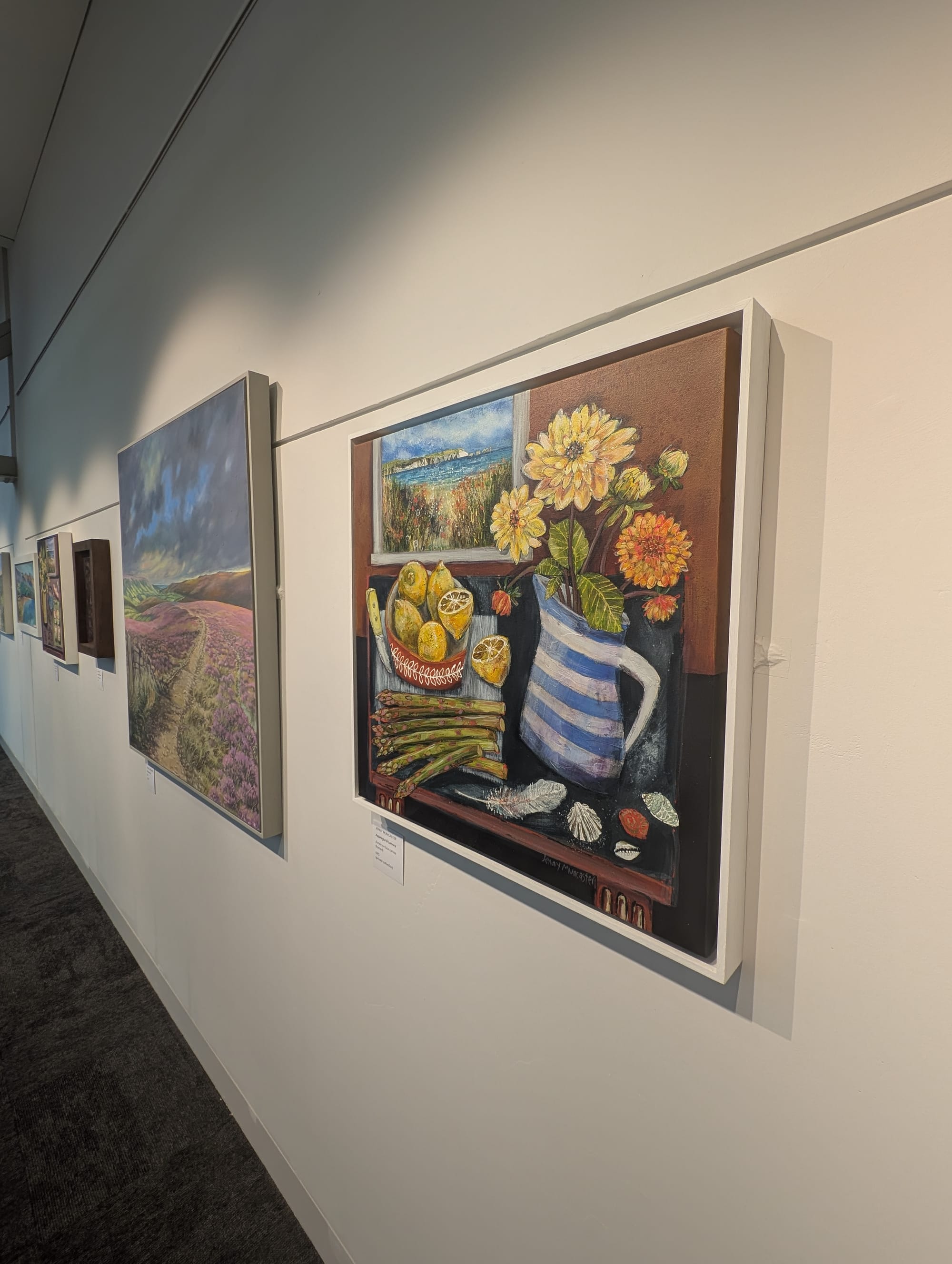
It would be a brilliant experience for anyone to display in this way, whether you're A Scottish Colourist or from a studio in Winchester. It is an incredible feeling. Sometimes when you step away from a work, and you see it in a slightly different context, you realise that it is alright. I can't wait to go back and have another look. It's brilliant. Yeah, very different from your studio setup.
The Colour Factory Artists: The Everyday runs until the 26th of July. Artworks are available for purchase. You can see more of Jenny’s fantastic works on her website here: Jenny Muncaster, Artist and Presenter | Explore Creative Artistry – Join Today